dinno.io · Product Builder
The phone was already in the bag. We just taught it to scream.
2026
“BagWatch wasn’t born in a pitch deck. It was born in a sentence: I wish this existed.”
Background story
Most “security products” start with hardware catalogues and threat models.
BagWatch started with a quieter kind of fear.
You’re in a café. Your bag sits under the chair — wallet, keys, the afternoon’s plans. You only need a moment: the restroom, another coffee, a call outside. And in that moment a thought appears, uninvited: What if someone simply walks away with it?
Not a heist. Not a movie. Just the ordinary risk of looking away for thirty seconds.
Someone once asked me, “How are you brave enough to leave your stuff on a chair?” It wasn’t bravery. I just really needed the restroom.
That’s when the idea became almost embarrassingly clear. We already carry a computer, a speaker, and a motion sensor in our pocket. We drop that computer into the bag every day — screen locked, camera down, doing nothing useful while we step away.
So why not make the phone the guard?
No Bluetooth tag to remember. No subscription gadget to charge. No cloud dashboard watching your life. Just the device that’s already there — armed with one tap.
The first seed of that idea appeared during my degree program: a rough prototype — a speaker wired to a phone — proof that “alarm in the bag” could feel real. A few years later, the product didn’t need the wire anymore. The whole thing could collapse into a single app: design, engineering, and business, built by one person who refused to wait for a perfect plan.
What I did
Shipping BagWatch meant wearing every hat — and refusing to hide behind any of them.
I didn’t start with a hundred-page PRD. I started with a feeling on screen: a siren that pulsed when armed, a single decisive button, a countdown that said you still have time to zip the pocket. Vibe coding got me moving fast. It also exposed a truth I now say out loud:
“Vibe coding gets you moving. It does not get you shipped.”
So the vibe met craft.
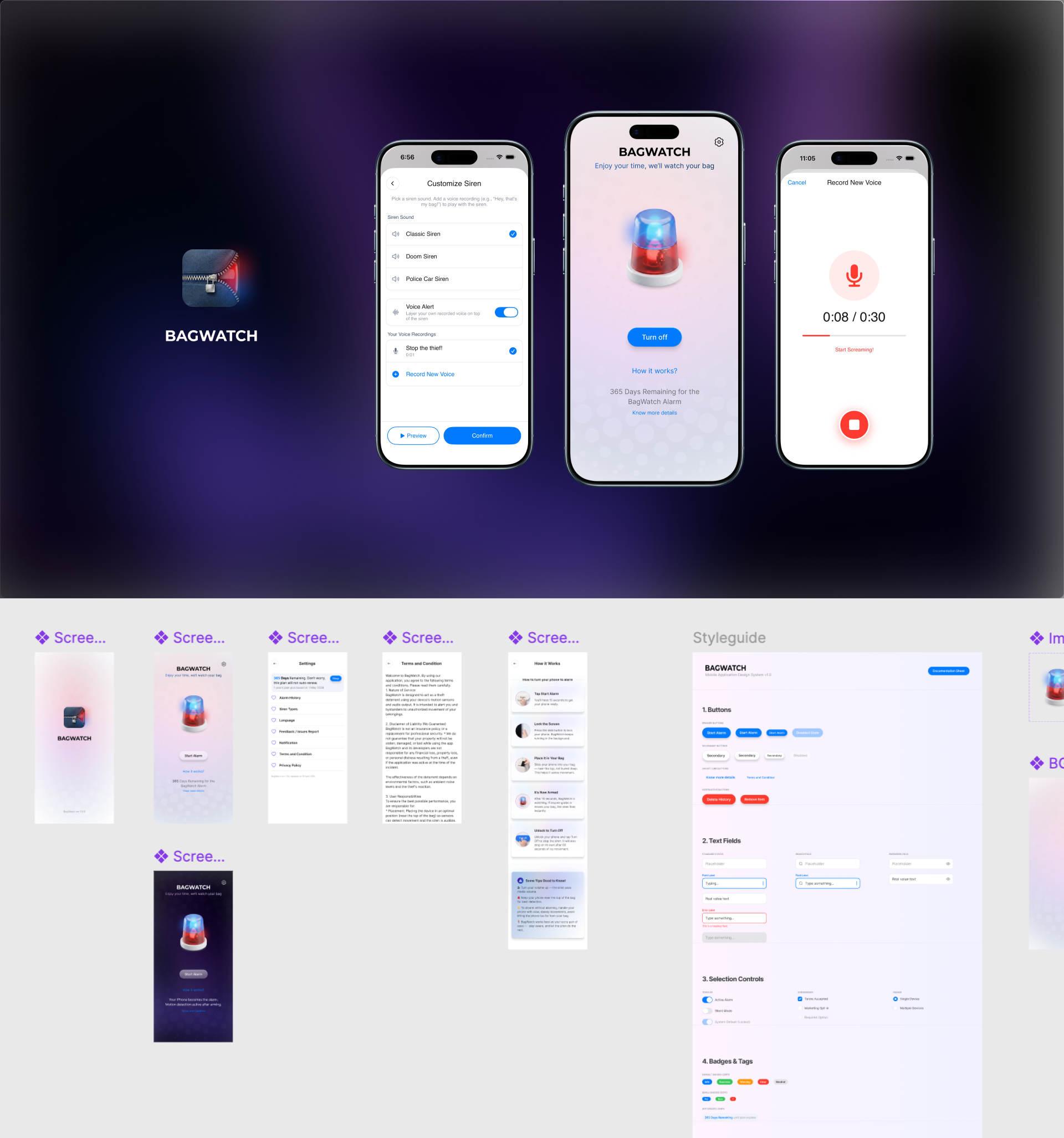
In Figma, I washed off the “AI smell” — that generic look where software guesses what an app should be. The siren stopped being clip-art and became the emotional centre of the product: the thing you stare at for fifteen seconds while your heartbeat settles.
Then I built a loop I still document in public: design a master language in Figma, expand screens with Cursor from that system, and when the output drifted, pull it back into Figma through MCP, retouch, and send it forward again. That rhythm — human taste, machine speed, human taste again — is the real “how I worked.”
But screens don’t steal bags. Reality does.
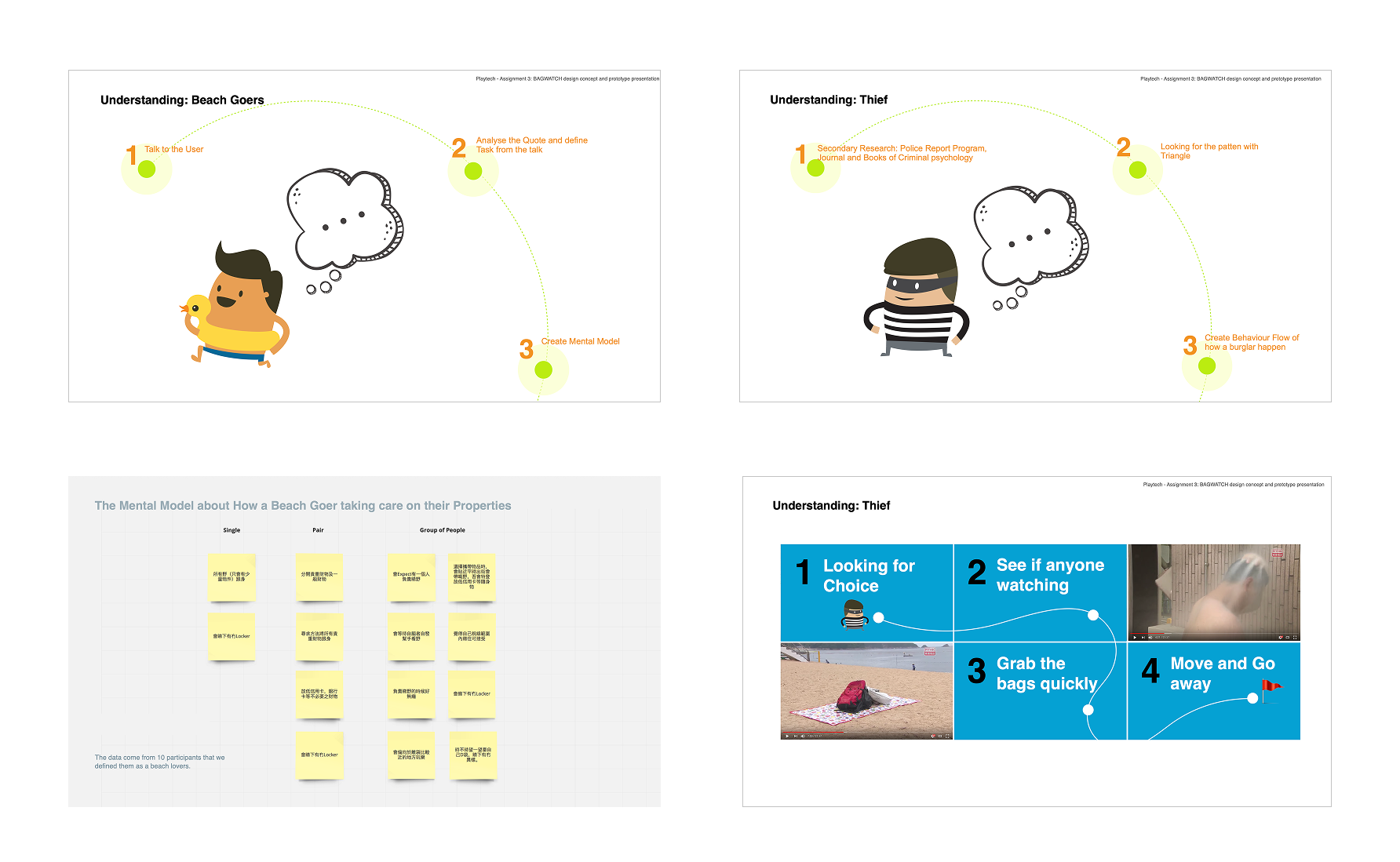
So I turned a living room into a crime scene. Different bags. Staged grabs. Xcode screaming motion labels. Patterns fed back into analysis until “stolen” and “I just picked up my own phone” stopped looking the same on a chart.
Then came sound — because a silent anti-theft app is a flashlight with anxiety. I couldn’t force iOS past its physical volume limit. So I stopped fighting the speaker and started designing for the ear: frequencies that cut through a café the way a cry or an ambulance does. And when every real tester asked for a custom voice the day before launch, I didn’t park it in Phase 2. I put recording into the build that night.
Finally I submitted to Apple — and learned that “ready” is a feeling, not a fact.
How it works
Great products disappear into a gesture.
BagWatch’s gesture is three steps:
- 01
Start Alarm
One tap. The phone arms itself.
- 02
Put the phone in the bag
Zip it away. No second device. No pairing ritual.
- 03
Walk away
If the bag is lifted, yanked, or dragged like a theft — the phone becomes a siren. If you come back and disarm it, life continues.
Underneath that simplicity is a promise with teeth: the alarm must fire when it matters, and must not fire when you’re simply retrieving your own phone. It must be loud enough to interrupt a room — even muffled by fabric. And it must respect privacy: protection without turning your bag into a tracked object on someone else’s server.
“Arm, leave, trust.”
The conflicts
Every elegant idea hides three ugly negotiations. Three conflicts. One product. No place to hide.
The sensitivity paradox
If the alarm is shy, the product is theatre. If the alarm is paranoid, the product humiliates its owner in a quiet room. BagWatch had to scare a thief without treating you like a suspect.
The physics of fear
An iPhone speaker is small. A bag is a muffler. “Louder” is not a setting Apple lets you invent. I needed attention that survives fabric, books, and noise — without pretending hardware limits don’t exist.
The business of trust
People don’t use a bag alarm every hour. They use it in moments. Pay-once caps the company. Ads poison a safety tool. And my north star — fully offline, no tracking backend — collided with App Store reality: Restore Purchases for a non-renewing year plan demanded a server I refused to build.
Breakthrough
Breakthrough wasn’t a slogan. It was a set of decisions that let the promise survive contact with the world.
On motion
I stopped hunting for one magic threshold and built a system of detectors — lift, snatch, drag, walking, sustained movement — tuned so dignity won over hair-trigger panic. A fraction of a second against a thief is worthless if you train users to hate false alarms.
On sound
I stopped demanding impossible volume and designed for human hearing: the 2–5 kHz band that refuses to be ignored. Custom voice became part of launch because fear is personal — and testers already knew that.
On business
I took the harder honest path. To keep BagWatch offline, I pivoted to an auto-renewing subscription so Restore could work without a surveillance backend — then rewrote every line of copy that had proudly promised we’d never do that. Ego lost. The product shipped.
“On June 18, Apple said yes. The relief lasted about five minutes. Then came the next chapter: telling the story so other people could feel the café moment too.”
That’s BagWatch.
Not a gadget empire. A small, sharp answer to a human hesitation — built end-to-end, argued with physics and policy, and released into the real world.
- Product Design (Figma)
- iOS Engineering (SwiftUI)
- Motion UX & Sensor Tuning
- Audio / Siren Design
- App Store Launch & IAP
- Build-in-public Content
See the real product in the wild.
bagwatch.dinno.io↗